Cool Runnings to Cold Gold: Jamaica’s Impossible Journey Becomes Legendary Reality
- TDS News
- Sports
- November 25, 2025
By: Donovan Martin Sr, Editor in Chief
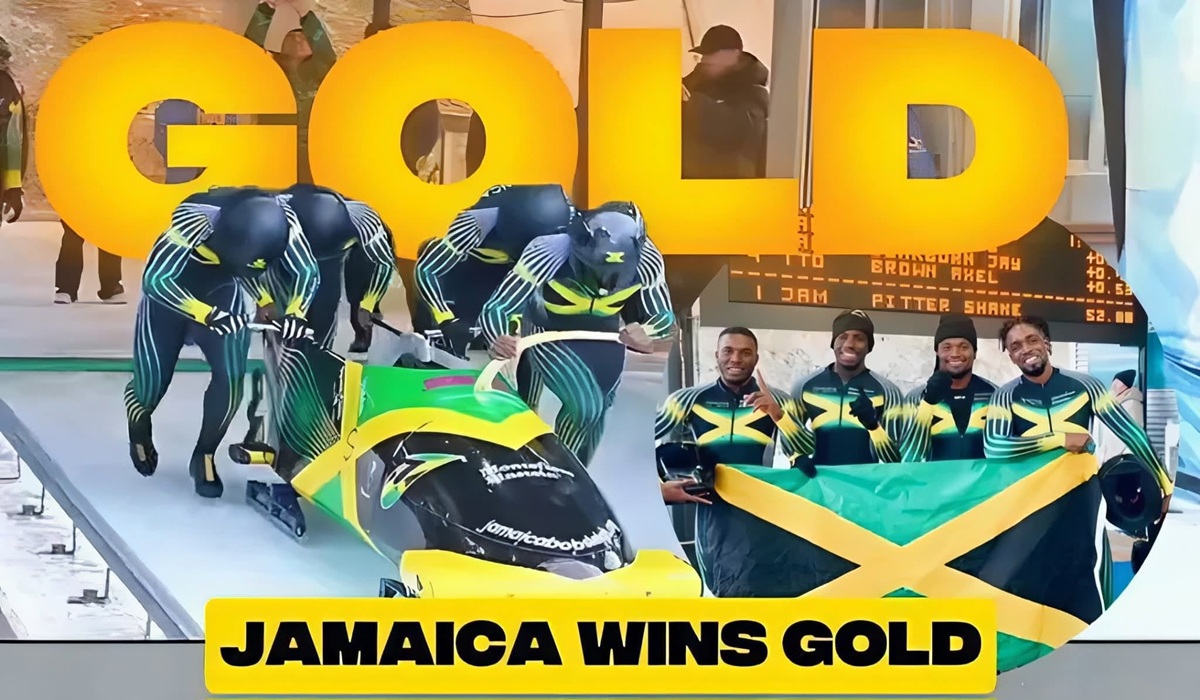
On a frozen track thousands of miles from sunlit beaches and palm-lined roads, Jamaica’s bobsled team has done what once seemed impossible. They have taken gold on one of the world’s most demanding ice runs in Whistler, standing at the top of the podium in a sport that was once used to mock their ambition. This was not a novelty headline or a lucky break. This was the result of years of discipline, engineering, refinement, endurance, and belief — a belief that a small island nation could master a sport born in the snow.
To understand the magnitude of this moment, you have to go back to the beginning. Jamaica first entered the winter sporting world at the 1988 Winter Olympics in Calgary. It was bold, daring, and to many, laughable. A country known for sprinting, heat, music, and movement stepping onto a frozen stage dominated by nations who had grown up surrounded by snow and ice felt, to outsiders, like a punchline waiting to happen.
Then came the film.
In 1993, Cool Runnings, starring John Candy, captured the heart of the world. It was funny, touching, emotional, and unforgettable. But it also locked the early Jamaican bobsled narrative into a permanent underdog frame. The team became symbols of courage and comedy, not necessarily of future dominance. It was a beautiful story — yet in many ways, it also froze the team in time as a charming anomaly rather than a serious, long-term contender.
But the athletes never believed that version of themselves.
While the world replayed the movie, the real team kept working. They returned year after year. They studied the science of speed. They invested in better sleds. They strengthened their bodies, synchronized their starts, refined their technique, and learned every subtle language of the ice. Each season erased another piece of the joke and replaced it with respect. Jamaica didn’t just show up anymore. Jamaica began to challenge.
That evolution reached its glorious peak in Whistler.
On a track known for its speed, danger, and ruthless curves, the Jamaican team launched with precision and authority. Their start time was explosive. Their lines were clean. Their rhythm was flawless. Every bend of the course reflected hours of commitment and unspoken trust between teammates. When the clock revealed their final run, there was a moment of silence… and then the realization swept across the crowd.
Jamaica had won gold.
And just as powerful — Team Canada surged onto the podium as well, capturing the second and third positions in the same event. It became a sweep not just of medals, but of meaning. On Canadian ice, in front of a shared audience, Jamaican excellence and Canadian excellence stood side by side in a historic, unified moment. It was a day where competition transformed into collective celebration, where two nations linked by history, migration, and identity stood together at the very top of the sport.
This victory means far more than sport. Jamaica has been facing difficult and uncertain times — economic strain, rising costs, social pressures, and the long shadows left by natural disasters. In the midst of all that, this gold medal arrives like a burst of sunlight breaking through storm clouds. It is a reminder that greatness can rise from struggle. That pride is still alive. That joy is still possible. That hope is still ours.
For Jamaican Canadians and for the wider diaspora across this country, the moment is layered with emotion. To see athletes of Jamaican heritage standing on a Canadian podium, sharing that space with Team Canada as they took silver and bronze, is a rare and beautiful convergence of two homes. It is proof that you do not have to choose one identity over another. You can honour both at the same time. It is a reminder that Canada did not just host this victory — it helped shape it. The training grounds, the competitive environment, the high-performance culture of Canada’s bobsled program all played a part in sharpening this achievement.
This gold medal, while deeply Jamaican, is also a quiet celebration of Canadian excellence, inclusivity, and opportunity.
For Canadian Jamaicans, it is the pride of ancestry and the pride of citizenship rising together in a single unforgettable image. Two flags. One frozen finish line. One historic moment.
Across Kingston, Montego Bay, St. Andrew, rural parishes, as well as Toronto, Brampton, Winnipeg, Vancouver, Montreal, London, and New York — the celebration echoes. Grandparents who remember 1988. Parents who grew up watching Cool Runnings. Children who never thought snow had anything to do with them. All now share in one powerful truth: Jamaica is no longer a punchline in winter sports. Jamaica is a champion. And Canada stood right there, shoulder to shoulder, on the podium of history.
One quiet voice from the team captured the feeling simply:
“We didn’t just win for ourselves. We won for Jamaica, for our people, for everyone who was told they didn’t belong.”
And in the same breath, every Canadian watching knew — this was also a day to be proud of the country that made it possible.
It is not just a medal.
It is history rewritten.
It is identity reaffirmed.
It is unity in motion.
From Cool Runnings to cold, unbreakable dominance — this is not just full circle.
It is a joyous day to be Jamaican.
A proud day to be Canadian.
And a legendary day for the diaspora.
About The Author