Rubio’s Escalation: Using a Terror Label to Push the U.S. Toward Imminent War With Venezuala
- Ingrid Jones
- Breaking News
- November 17, 2025
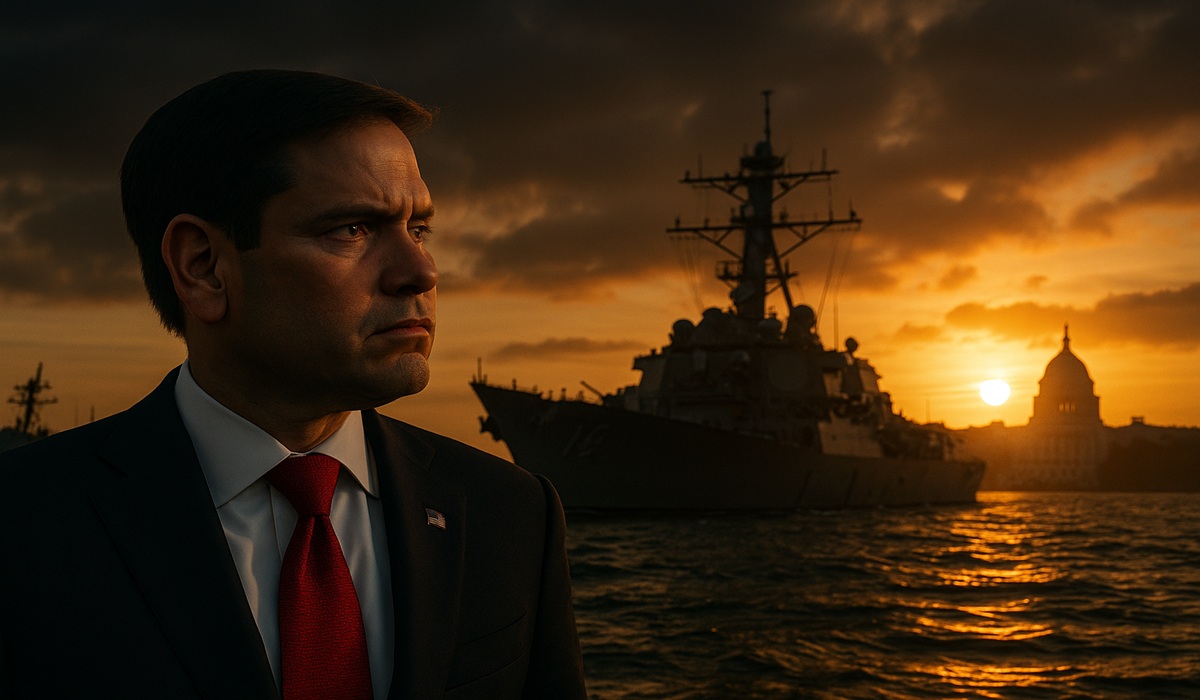
Washington’s relationship with Venezuela entered a volatile new phase when the United States announced it would designate the Venezuelan network known as Cartel de los Soles as a foreign terrorist organization. The declaration was delivered by Secretary of State Marco Rubio, who asserted that the group operates as a violent criminal enterprise intertwined with Venezuela’s political and military leadership. In the announcement, Rubio tied the organization directly to President Nicolás Maduro and prominent officials within the Venezuelan state, arguing that the regime itself functions as a criminal structure responsible for drug trafficking and destabilizing violence across the hemisphere.
Cartel de los Soles — named for the sun insignia worn by Venezuelan military generals — has long been alleged by U.S. agencies to be a network of high-ranking officials involved in drug trafficking and corruption. For years these accusations remained within the realm of sanctions, criminal indictments, and diplomatic pressure. Elevating the group to a terrorist designation represents a major escalation, unlocking a wider range of U.S. tools including military authority, intelligence operations, asset seizures, and expanded unilateral action. By linking Maduro to the organization, Rubio framed the Venezuelan state itself as a narco-terror apparatus, creating a legal rationale for more aggressive intervention.
To understand why Rubio is driving this policy with such intensity, one must look beyond the immediate context and into his long political trajectory. Rubio has shaped his national identity around a fierce anti-communist worldview rooted in his Cuban-American background. For him, the governments of Venezuela and Cuba are not just political adversaries; they represent ideological threats tied to the history of Castro’s Cuba, the exile community in Florida, and decades of U.S. policy battles over hemispheric influence. Rubio has consistently argued that Venezuela, Cuba, and Nicaragua form a regional axis that undermines democratic governance, supports transnational criminal networks, and threatens U.S. interests. His rhetoric toward these states has often been uncompromising, describing them as enemies of freedom and humanity.
Venezuela’s close relationship with Cuba deepens Rubio’s animosity. For years Venezuela supplied Cuba with heavily subsidized oil and strategic support, while Cuban advisers and intelligence specialists maintained significant influence inside Venezuela’s security apparatus. That partnership allowed both countries to withstand diplomatic isolation and U.S. sanctions. Rubio sees this alliance as a direct challenge to U.S. regional authority, and dismantling it has long been one of his foreign-policy priorities. The terrorist designation of Cartel de los Soles — and the direct accusation that Maduro leads it — is therefore more than a punitive measure. It is a strategic attempt to weaken the Venezuelan-Cuban axis and push Venezuela back into a state of political vulnerability.
This shift comes at a moment when tension is already rising. Recent U.S. naval deployments in the Caribbean and escalating accusations from Washington have led to fears that the designation could be used to justify more forceful actions. For decades U.S. policy toward Venezuela oscillated between sanctions, diplomacy, and isolation. Declaring a foreign government’s inner circle a terrorist network marks a dramatic departure. It moves the conversation from economic pressure to war-level framing, suggesting that the U.S. could act unilaterally against individuals or institutions inside Venezuela under counterterrorism authority.
The Maduro government has denounced the designation as politically motivated, arguing that it is part of a long-running attempt to destabilize the country. Regional governments have watched cautiously, aware that expanded U.S. action could destabilize neighboring states already strained by migration, inflation, and economic hardship. Within this broader landscape, the key question is not whether the United States can justify such a designation — but where the policy leads next. Terrorist designations are rarely symbolic. They often precede covert operations, interdictions, and escalatory moves justified under national security law.
In many ways, this moment is the culmination of Rubio’s long campaign to portray the Maduro government as both illegitimate and criminal. His personal and political identity, shaped by the history of Cuban exile and anti-communist activism, has created a worldview in which Venezuela represents more than a foreign adversary. It is the frontline of a generational battle over the future of the Western Hemisphere. By linking Maduro directly to a designated terrorist organization, Rubio has created the legal, political, and ideological foundation for far more aggressive U.S. intervention. Whether this leads to open conflict, deeper sanctions, or a new era of regional fragmentation remains to be seen. But the significance is unmistakable: the United States has crossed a threshold that could define its Latin American policy for years to come.
About The Author