María Corina Machado and the Paradox of a “Peace” Laureate Calling for War
- TDS News
- Breaking News
- November 4, 2025
By: Donovan Martin Sr, Editor in Chief
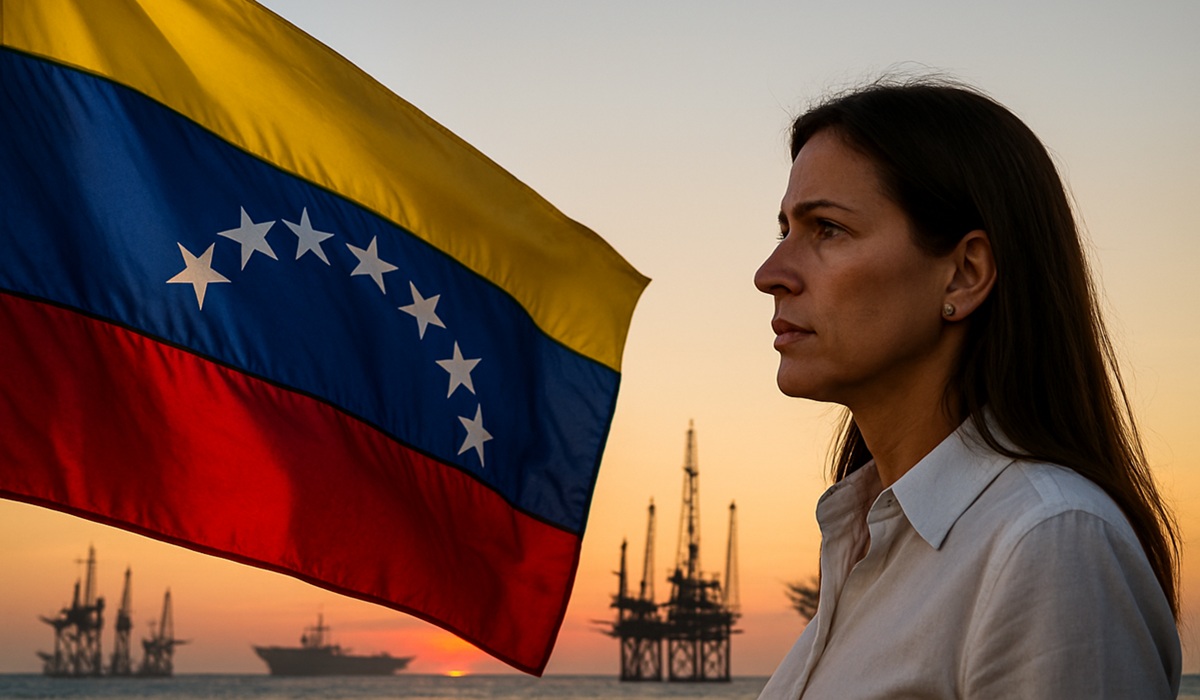
The arc of political struggle is often more complicated than the slogans crafted to define it. In Venezuela today, few figures embody that tension more than María Corina Machado — the outspoken opposition leader who has become a global symbol for democratic resistance while simultaneously courting the most powerful military force on Earth to intervene against her own government. Awarded the Nobel Peace Prize for her activism, she stands at the intersection of moral symbolism and realpolitik, lauded internationally yet polarizing domestically, a champion of democracy to some and a potential catalyst for foreign-driven conflict to others. In this tension lies the fundamental question: when does the pursuit of freedom become indistinguishable from the doorway to foreign domination?
Machado’s rise is neither quiet nor provincial. She has been a central figure in the Venezuelan opposition for more than a decade, uncompromising in her rejection of Chavismo and in her criticism of President Nicolás Maduro. In the last election, she garnered acclaim abroad for mobilizing opposition forces in what many global observers framed as a courageous effort to confront authoritarianism. It is difficult to ignore the resonance of a lone civilian voice taking on the machinery of a state. Yet it is equally impossible to ignore the geopolitical orchestra playing behind her podium.
For here is the truth few Western capitals are ever eager to admit openly: when Washington anoints a foreign political leader, it rarely does so out of pure moral concern. Venezuela is home to the largest proven oil reserves on the planet. History is a repetitive instructor — when resources align with geopolitics, democracy becomes an accessory rather than the principle. Machado was recognized by the United States and several allied governments as the “legitimate leader” of Venezuela despite losing the election, citing fraud and corruption. Maduro and international observers countered that the vote was fair. Two stories, two narratives, two truths depending on who tells them. But one certainty emerges — Washington did not christen an opposition leader out of benevolence. Power never moves without price.
The unspoken bargain whispered in policy circles is clear: U.S. blessing often comes with American access to oil, influence, and strategic latitude. And Machado appears acutely aware of this, navigating back channels, aligning her rhetoric with the interests of the United States and Western partners, and signaling willingness to recalibrate Venezuela’s geopolitical loyalties. She has publicly voiced openness to U.S. military intervention — a line most national leaders, even those in exile or opposition, will not cross. The statement is not merely provocative. It is incendiary. It suggests that gaining power, in her eyes, may justify welcoming the bombardment of her own soil.
It is here that the principles fracture. Leadership, especially leadership framed as democratic salvation, demands loyalty first to one’s people. Patriotism is not measured by flags waved at rallies but by what sacrifices one will refuse to demand of one’s own citizens. When an aspiring head of state invites foreign firepower to settle a domestic struggle, the ethical equation shifts violently. If the world’s most lethal military machine were to descend upon Venezuela — as current U.S. President Donald Trump again asserts is possible — it would not be lasers delicately aimed at corrupt bureaucrats. It would be missiles, drones, collateral damage, military occupation, and the irreversible reshaping of national destiny by forces that do not answer to Venezuelan voters. Venezuelan sovereignty would not be reborn; it would be pawned.
History is unambiguous on this point. From Iraq to Libya to Afghanistan, the script is painfully familiar: Western support for regime change, airstrikes under the banner of liberation, promises of democracy, then years of chaos, fractured governance, privatized resource extraction, and a nation left to pick up the broken pieces once the strategic value is exhausted. The oil flows, the contracts are signed, and the streets of the “liberated” country fill not with hopeful citizens but with the disillusioned and displaced.
Machado’s applause line that she would move the Venezuelan embassy to Jerusalem — a move historically aligned with U.S. strategic doctrine rather than Venezuelan political tradition — speaks to another uneasy alignment. It signals not independence, but acquiescence. It positions Venezuela not as a sovereign republic reclaiming democratic dignity, but as a geopolitical appendage serving the interests of another capital. And the fact that she is not even in the constitutional line of succession underscores the reality: her path to leadership is not electoral inevitability but foreign enforcement. That alone should stir deep discomfort in Venezuelans across political lines.
To be fair — and fairness matters — Machado does not arise from fiction. Many Venezuelans are exhausted by economic collapse, rolling shortages, inflation measured in humanitarian suffering, and governance they view as corrupt or ineffective. Her supporters believe she offers a new dawn, a chance to break a cycle of mismanagement and reclaim prosperity. Her grievances about electoral integrity may have grounding. Democratic systems, especially in contested environments, rarely produce clean narratives. But legitimate grievances do not automatically sanctify the remedies proposed. And when the prescription is foreign military intervention, the cure can become deadlier than the disease.
What complicates the picture further is the Nobel Peace Prize resting on her shoulders. Awards of this kind are often political instruments disguised as moral recognition. They sanctify the recipient in the global imagination, shaping public memory in advance of historical verdict. Yet there is an unavoidable contradiction in celebrating a figure for peace while that same figure signals openness to war. Prizes speak to ideals. Leaders act in realities. And sometimes the two collide violently.
This is not unprecedented. Barack Obama received the Nobel Peace Prize at the dawn of his presidency, even as the wars he inherited expanded and drone strikes multiplied. The Nobel Committee is no stranger to geopolitics. Peace, at times, becomes the veneer through which power grants legitimacy to those it hopes will shape the world in its image. Machado’s elevation falls in that tradition — a symbolic victory for democracy wrapped in strategic calculus.
But Venezuela is not a chessboard; it is a nation of families, workers, and communities struggling for dignity in a world eager to reduce them to pawns. War is not theoretical to people who would live beneath its skies. Bombs do not distinguish between supporters of one party or another. When a political leader signals willingness to risk foreign fire on their homeland, the public must ask: whose future will rise from the rubble?
The most unsettling reality is that if Washington’s strategy succeeds and Maduro falls through foreign pressure or military force, Machado’s ascent will not be the triumph of Venezuelan agency. It will be a transfer of sovereignty wrapped in the language of liberation. The oil wells will not hum for the Venezuelan public. They will hum for markets far from Caracas, profits flowing outward while the Venezuelan people face the slow grind of rebuilding under the shadow of foreign stewardship.
There is wisdom in the old adage that the best leaders are those who do not crave power. They seek responsibility reluctantly, guided by duty rather than ambition. In Machado’s case, ambition is not merely evident — it is incandescent. And ambition divorced from restraint, tethered to the endorsement of nations with vested interests, can become a danger disguised as salvation.
This is not to defend Maduro, nor to dismiss the frustrations of millions who demand reform and accountability. Venezuela’s path forward will not be built on denying its crises. But neither will it be built on surrendering sovereignty to the highest-powered foreign bidder. Democracy cannot be imported at gunpoint. It must be earned, fought for, and defended internally, through institutions and collective will — not brokered through carriers and missiles over Caribbean waters.
For those who admire Machado as a symbol of resistance, the question is not whether she has courage. She clearly does. The question is whether her vision of victory leaves Venezuela free — or merely free-falling into the arms of geopolitical patrons who view the country not as a people, but as a resource map.
Peace has meaning only when it protects human life. Democracy has meaning only when it preserves self-determination. To win both, Venezuela must not trade one peril for another. The tragedy would not be choosing the wrong leader. The tragedy would be believing that liberation arrives strapped to foreign warheads.
History offers warnings. Venezuela must decide whether to heed them — before the world decides on its behalf.
About The Author