3D Printing in the Classroom: A Helpful Guide for Teachers
- Casey Cartwright
- Technology
- November 3, 2025
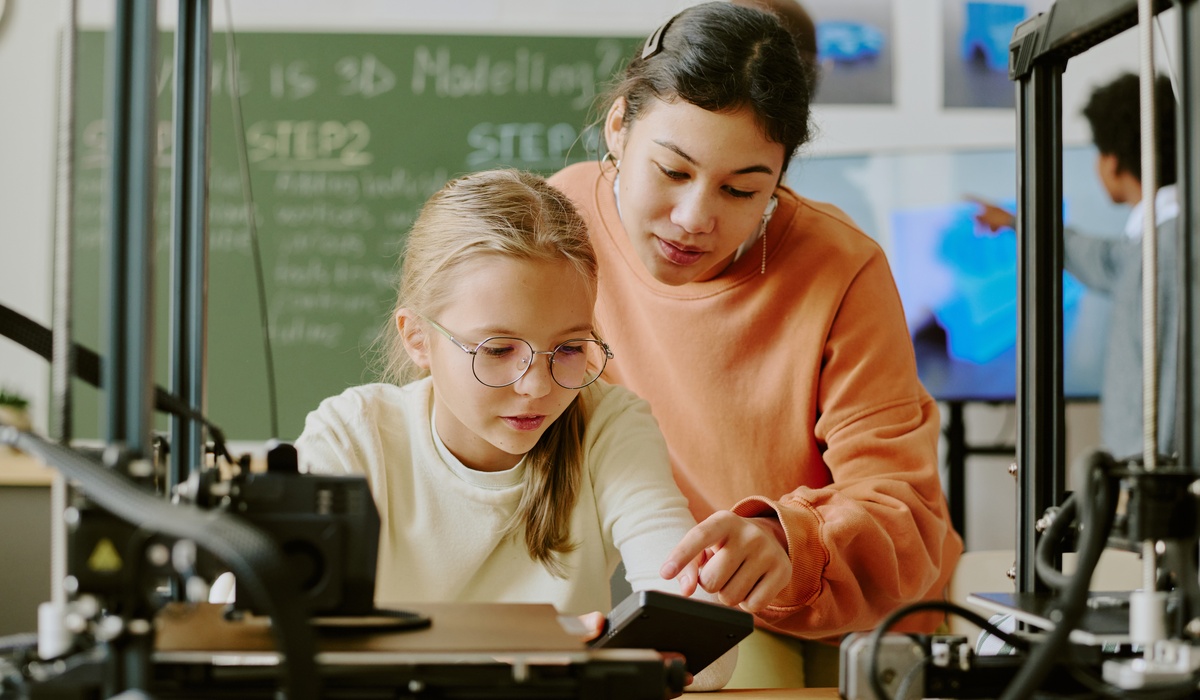
Nowadays, it might seem like 3D printers are everywhere, from high-tech labs to maybe even your local library. What once was a novel technological advancement is now a manufacturing tool that everyone from scientists to middle schoolers can use. In fact, you can bring 3D printing into your classroom to offer your students hands-on learning and tech-savvy skill development. This helpful guide is for teachers wanting to do just that. We’ll cover what exactly 3D printing is, why it’s a fantastic tool for elementary students, and how you can get started.
What Is 3D Printing?
3D printing is a manufacturing process that extrudes heated filament to construct parts one layer at a time. Whereas a regular printer puts ink on paper to create a 2D image, a 3D printer uses plastic substances to build a physical, three-dimensional object from a digital file. This process is also called additive manufacturing because it adds material layer by layer to create the final product.
Here’s a simple breakdown of how it works:
- You start with a digital design. This is a 3D model of the object you want to create, which you can make with special software or download from a website.
- The design is sent to the 3D printer. The printer’s software “slices” the digital model into hundreds or thousands of thin horizontal layers.
- The printer builds the object. It heats up a plastic filament (which looks like a spool of thick string) and extrudes it through a nozzle, carefully building the object one layer at a time, from the bottom up.
- Voilà, you have a physical object! After some time, your digital design becomes a real thing you can hold in your hand.
Why Use 3D Printers in an Elementary Classroom?
You might be thinking, “This sounds cool, but is it really useful for my students?” Absolutely! A 3D printer isn’t just a fancy gadget; it’s a powerful educational tool that can transform how students engage with different subjects.
Making Abstract Concepts Concrete
Some ideas are tough for kids to grasp just by reading a book or looking at a picture. With a 3D printer, you can make these abstract concepts tangible. Imagine your students holding a 3D model of a DNA helix during a science lesson, examining a miniature Roman aqueduct in history class, or feeling the different parts of a plant cell. This hands-on interaction helps them build a deeper, more lasting understanding of the material.
Boosting Creativity and Problem-Solving Skills
3D printing encourages students to think like inventors and engineers. The process of designing an object, printing it, and then seeing what works (and what doesn’t) is a fantastic exercise in problem-solving.
Students learn to think critically, adjust their designs, and try again. It’s an iterative process that builds resilience and a growth mindset. For example, a student might design a toy car, print it, and then realize the wheels don’t turn. This gives them a real-world problem to solve, motivating them to redesign and improve their creation.
Integrating STEAM Learning
3D printing is a natural fit for STEAM (Science, Technology, Engineering, Arts, and Mathematics) education. A single project can involve all five pillars in some way, such as these:
- Science: Exploring biological models or physics principles.
- Technology: Learning to use design software and operate the printer.
- Engineering: Designing and building functional objects.
- Arts: Creating sculptures, custom key chains, or other artistic pieces.
- Mathematics: Applying concepts of geometry, measurement, and scale to their designs.
This interdisciplinary approach helps students see the connections between different subjects and prepares them for future challenges. Overall, 3D printing is a fantastic way to elevate learning with technology.
Getting Started with 3D Printing
Ready to give it a try? Getting started is more manageable than you might think. Here’s a step-by-step approach to bringing 3D printing into your classroom.
1. Buy a Printer
You don’t need a top-of-the-line industrial machine. Many manufacturers now offer printers specifically designed for educational settings. When you’re looking for a printer, consider these factors:
- Ease of use: Look for a printer with a user-friendly interface and simple setup.
- Safety features: An enclosed printer with a covered nozzle is a safer choice for a classroom with curious kids.
- Durability: A sturdy, reliable machine will save you headaches down the road.
- Support: Good customer support and a strong online community can be super helpful when you run into issues.
Some popular entry-level printers for educators include models from Creality and FlashForge, and those are just two of many, many options. Spend some time finding the right fit for your classroom. You should find that the difficulty level of learning 3D printing is much lower with models designed with students and beginners in mind.
2. Find 3D Models To Create
You don’t have to be a professional designer to find great models to print. There are huge online communities where people share their designs for free. Websites like Thingiverse, MyMiniFactory, and Tinkercad are treasure troves of ready-to-print files, ranging from historical artifacts and scientific models to fun toys and games.
Once you’re more comfortable, you and your students can try creating your own designs. Tinkercad is a fantastic, free, web-based tool that is perfect for beginners. Its simple drag-and-drop interface allows students to combine basic shapes to build complex objects, making it an accessible entry point into the world of 3D design.
3. Integrate the Tech Into Your Curriculum
The best way to make 3D printing meaningful is to connect it directly to your curriculum. Here are a few ideas to get you started:
- Social studies: Print models of famous landmarks like the Eiffel Tower or the Pyramids of Giza.
- Language arts: Have students design and print a physical representation of a character or a key object from a book they’re reading.
- Math: Print geometric shapes, custom manipulatives, or tools like rulers and protractors.
- Science: Create models of dinosaur fossils, planetary systems, or different types of molecules.
Final Thoughts
A 3D printer, beyond being a nifty tool for making plastic trinkets, is a gateway to deeper learning, creativity, and problem-solving. It empowers students to become creators, not just consumers, and gives them a tangible connection to the concepts you’re teaching. We hope this guide helps you integrate 3D printing into your classroom and open up a new, exciting world of learning for your students.
About The Author