The Trillion-Dollar Mistake: How a Venezuela War Will Become America’s Biggest Catastrophe
- TDS News
- U.S.A
- December 2, 2025
By: Donovan Martin Sr, Editor in Chief
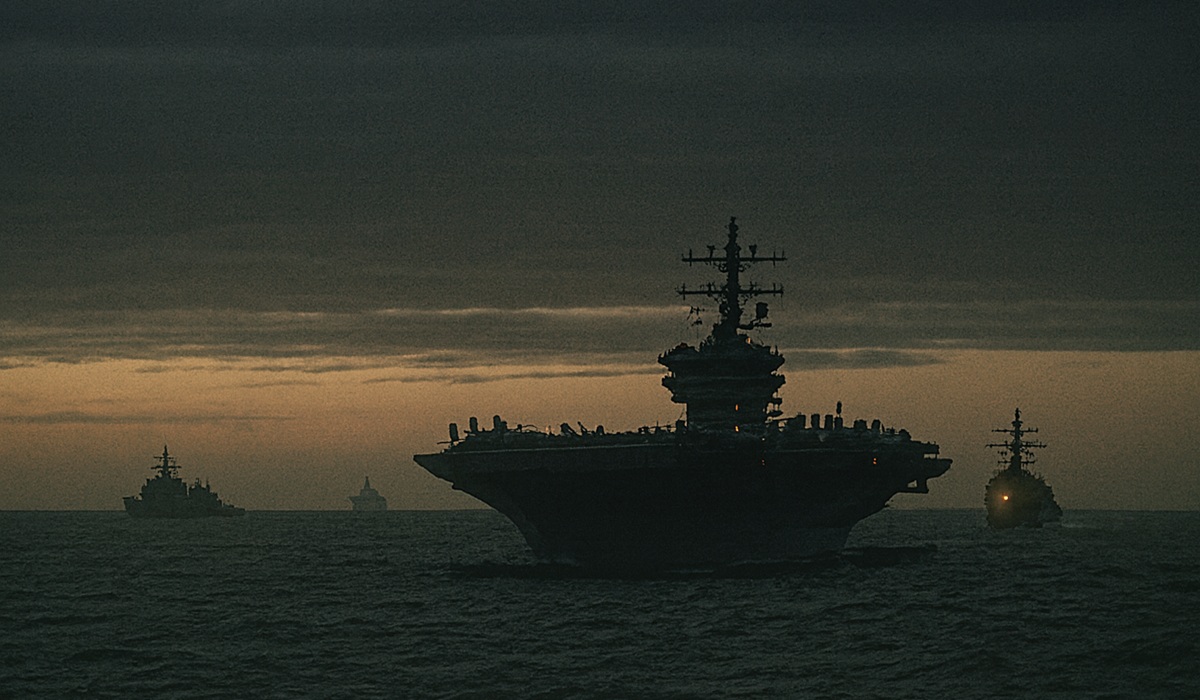
The sudden movement of U.S. carrier strike groups toward Venezuelan waters has the eerie feeling of déjà vu, the kind that whispers warnings from Iraq, Afghanistan, Libya, and every other foreign intervention that metastasized into something far larger, costlier, and bloodier than originally promised. Washington presents this buildup as routine deterrence, but nothing about it is routine. A single Nimitz- or Ford-class carrier is a floating city of steel and nuclear firepower, burning through millions of dollars per day just by staying operational. When two or more arrive, along with the destroyers, cruisers, supply vessels, submarines, and aircraft wings required to protect them, the meter begins running with a speed that would bankrupt most nations long before the first shot is fired.
Calculating the financial scale of a war with Venezuela requires starting with the architecture already in motion. A carrier strike group typically consumes between six and eight million dollars per day when fully deployed, and that number doesn’t even reflect the surges in fuel, maintenance, jet sorties, and munitions that accompany any combat scenario. If the U.S. maintains two strike groups in the Caribbean for a month, the cost approaches half a billion dollars. Extend that presence through a year, and the bill climbs toward five billion even before counting a single bomb dropped or a single troop deployed on land.
Within that evolving picture are three distinct possibilities. The first is a tightly controlled display of force — a low-intensity intervention where the United States tries to squeeze the Venezuelan government through naval pressure, intelligence overflights, special-operations activity, and heavy economic threats. In this scenario, the deployment remains offshore. The administration would lean heavily on psychological pressure, information campaigns, and diplomatic isolation while maintaining a constant naval presence. Financially, this scenario is deceptively expensive. Keeping major warships idling near Caribbean waters still requires an uninterrupted flow of fuel for aircraft, maintenance cycles, replacement parts, and the expensive logistics chain that supports every sailor, mechanic, and pilot. Even if not a single missile is launched, a year of low-intensity posturing could cost somewhere between seven and ten billion dollars, depending on the number of vessels and the tempo of operations. Add in the propaganda machinery — the messaging campaigns, the contractors hired to shape public opinion, the monitoring of online spaces, the constant drumbeat of talking points — and another billion could quietly evaporate through the back door of the federal budget.
Yet even this “restrained” path carries human risks. Close encounters at sea, misidentification of aircraft, accidents aboard carriers, or the unpredictable nature of shadow warfare could claim American lives. Historically, low-intensity operations have still resulted in casualties through helicopter crashes, training mishaps, or small skirmishes. A handful of deaths may not register on the congressional scoreboard, but they are real, devastating, and inevitable in any prolonged military operation.
The second possibility, and the most politically tempting for war planners, is a limited-strike campaign paired with a naval and air blockade. This would involve missile strikes on Venezuelan radar systems, command centers, oil refineries, air bases, and coastal defenses. It would be marketed to the American public as a quick, precise effort to “neutralize threats” or “restore democracy,” depending on which rhetorical coat Washington decides to wear. But limited wars are almost never limited in their economic footprint. The cost of precision-guided munitions alone is staggering; a single Tomahawk missile can run well over a million dollars, and an extended air campaign can burn through hundreds of them within weeks. Air Force bombers, Navy jets, refueling tankers, drones, reconnaissance platforms, and the sophisticated command-and-control networks that tie them together all add layers of cost invisible to the public and largely ignored by officials.
Under this second scenario, the United States could spend anywhere from twenty to forty billion dollars in the first year, depending on the intensity of the strikes and the duration of the blockade. What follows is even more expensive: the long tail of military operations. Equipment needs to be replaced, aircraft repaired, munitions stockpiled, and ships cycled back to dry dock. Blockades themselves are not free; they require constant flights, refueling, and surveillance. America’s naval presence becomes semi-permanent, which means the cost becomes semi-permanent as well.
And then there are casualties. No matter how “surgical” the operation, Venezuelan forces would respond. Anti-ship missiles, drone swarms, cyberattacks on American systems, sabotage, or asymmetric retaliation through regional allies could all claim American lives. Based on similar conflicts, U.S. military planners would privately prepare for dozens to hundreds of American casualties if the situation escalates into a prolonged confrontation. Official statements would never admit that, but history makes the math obvious.
The third scenario is the darkest of all: a full-scale invasion or long-term occupation under the assumption that Venezuela’s oil reserves must be placed under direct American control. This is the nightmare scenario that mirrors the worst lessons of the last quarter-century. Once U.S. ground forces land on Venezuelan soil — whether Marines securing ports or Army units establishing footholds — the conflict transforms instantly from a strategic maneuver into a generational commitment. Venezuela’s geography, thick with jungle terrain, mountains, dense cities, and hardened loyalist zones, would produce a conflict even more complicated than Iraq. Resistance networks would emerge overnight. Guerrilla factions would hit supply lines, convoys, and base perimeters. The global outrage would be immense, and the propaganda war alone would swallow billions as the U.S. government pours money into justifying its presence and masking civilian casualties.
Financially, a full-scale war could swallow a trillion dollars before the decade is out. Carrier groups would remain deployed for years. Air operations would run daily. Bases would be built, destroyed, and rebuilt. Contractors — whose fees often rival military budgets — would descend in droves. And if history holds, the true cost would not even be visible until long after the fighting stops. Veterans would return home with lifelong injuries requiring continuous care. Interest on wartime borrowing would accumulate for decades. The total price could easily mirror the combined costs of Iraq and Afghanistan, where the final bill soared into the trillions.
The loss of life in such a scenario would be catastrophic. American casualties could number in the thousands over a decade. Venezuelan casualties — civilian and military — would likely be far higher. Cities would be scarred, infrastructure ruined, families displaced, and young men and women on both sides lost to the chaos of a conflict that never needed to happen. This is the human cost that war planners treat as a line item, but which families carry forever.
What makes this potential conflict even more tragic is the underlying motive whispered through diplomatic back channels: control of oil. Venezuela possesses some of the largest proven oil reserves on the planet, and history shows how often resource-heavy regions become target zones for geopolitical muscle-flexing. Yet the lesson of the last two decades should be clear. Trying to seize another nation’s resources through force is not a strategy; it is a moral failure. It corrodes America’s image abroad, breeds resentment, empowers rivals, and destroys the very democratic ideals Washington claims to defend.
In this moment, the United States stands at a crossroads. It can choose diplomacy, energy diversification, and respect for sovereignty — or it can descend into another ruinous war that burns money, lives, and moral credibility at a pace that no nation can endure. One of the most consistent promises made by President Donald J. Trump, widely recognized as a president who avoided starting new wars, was simple: no more endless conflicts. If America abandons that principle now, the cost will not be measured in barrels of oil or square miles of territory. It will be paid in the shattered lives of young service members, the destabilization of an entire region, and the long shadow of regret that follows every preventable war.
Before a single bomb drops, before the first casualty report reaches a family’s doorstep, the United States must confront a simple truth: war with Venezuela is not strategy, not necessity, not defense. It is a choice — and it is a choice that would echo across generations, long after the seas have calmed and the carriers have slipped back into port.
About The Author