The Red String Theory: Why So Many Lives Seem Bound Together Long Before They Meet
- TDS News
- Trending News
- December 1, 2025
By Donovan Martin Sr, Editor in Chief
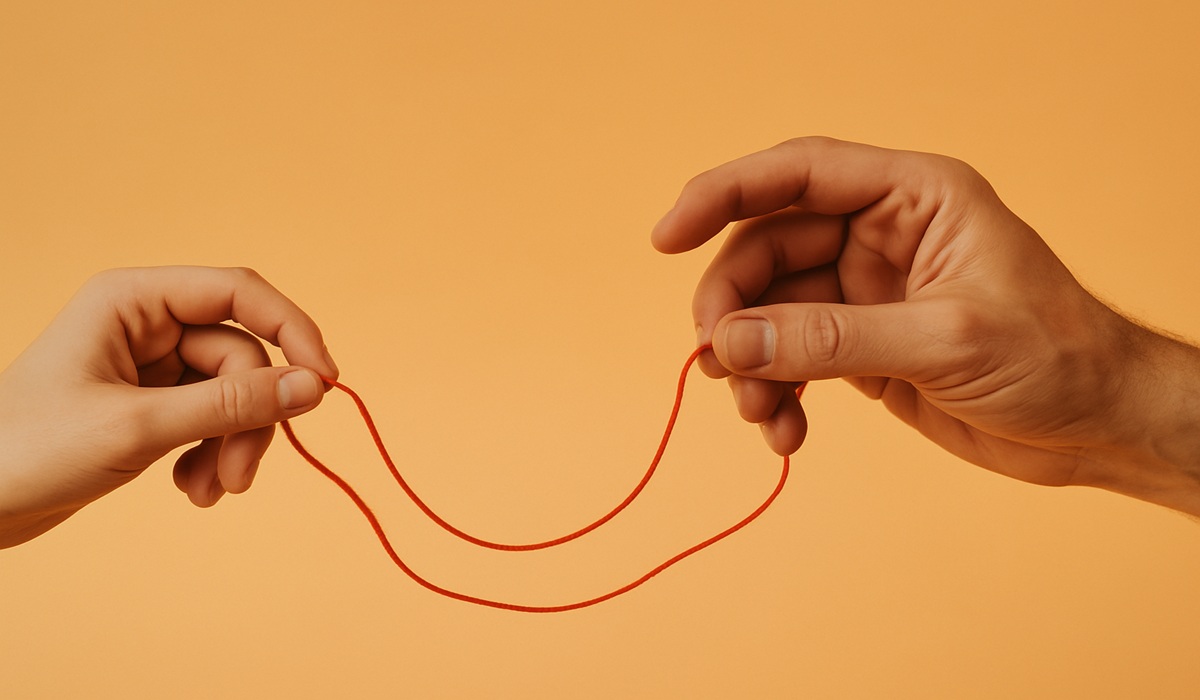
Every culture has its own way of explaining the strange coincidences that tie people together, but few ideas capture the imagination quite like the Red String Theory. It’s an old belief with deep roots in East Asia, suggesting that the most important people in your life—partners, lifelong friends, even long-lost relatives—are linked to you from birth by an invisible thread. The string stretches and twists, but never snaps, quietly guiding people toward one another across time, distance, and circumstance.
In ancient stories, the thread was tied by the gods themselves. In modern times, it’s ordinary people who keep the theory alive, because the evidence keeps showing up in ways that feel too unbelievable to ignore.
The most compelling stories come from couples who discover they appeared in the same childhood photographs years before they ever met. Two children standing a few feet apart on a crowded beach. A family photo with a future spouse blurred in the background. A school assembly where two strangers sat on opposite sides of the room, destined to one day build a life together. These coincidences feel almost cinematic, yet they happen often enough that many people stop calling them coincidences at all.
There are stories of people who grew up on the same street, attended the same festivals, and shared mutual friends, yet somehow never crossed paths until much later. Others find out through DNA tests that a coworker, neighbour, or long-time acquaintance is actually a sibling they never knew existed. Families have discovered they were circling each other for years—living parallel lives, shopping at the same stores, riding the same bus routes, standing in the same lineups—never realizing they were connected until fate finally revealed it.
These moments don’t feel random. They feel orchestrated.
Psychologists often describe these kinds of events through the lens of synchronicity—meaningful coincidences that carry emotional weight. Jung, who coined the term, believed they were clues from the subconscious, nudging people toward something important. That view comes surprisingly close to the old folklore, suggesting that life has a way of arranging encounters long before we notice their significance.
What makes the theory even more compelling today is technology. People now digitize decades of old photographs and home videos, and every once in a while someone finds a familiar face in an unexpected place. A spouse spotted in a frame from the 1980s. A best friend unknowingly caught in the background of a family vacation. These discoveries don’t rely on faith or folklore—they’re frozen moments of proof that certain lives intersect before the mind ever catches up.
But the theory doesn’t rely on romance alone. It also speaks to connections that change a person’s direction—mentors who appear at exactly the right time, friends who arrive when life is about to shift, strangers who later become essential. The idea is not that we are dragged toward people by destiny, but that the string keeps drawing us near until the moment is right. It’s timing, intuition, circumstance, and something else no one can quite name.
Its origin, though poetic, was never meant to be a scientific blueprint. The ancient storytellers weren’t trying to calculate probability; they were trying to explain why some meetings feel inevitable. Over time, the meaning expanded from soulmates to anyone who plays a defining role in a person’s life. It evolved from a myth into a metaphor for the invisible connections shaping our paths.
Even skeptics admit that life has a strange rhythm. People with similar values, energies, or backgrounds are naturally drawn to the same environments. They attend similar events, have similar habits, and move through spaces that make encounters more likely. In this interpretation, the thread symbolizes the internal compass that pulls people toward those who resonate with them long before the relationship forms.
Still, logic alone struggles to explain how two strangers can unknowingly share so many overlapping moments before meeting. There is something too intricate, too precise, about the timing. It leaves room for mystery, room for the possibility that life is more connected than we understand.
The theory endures because it comforts people, inspires them, and validates the sense that there is meaning behind the chaos. It suggests that the most important relationships in a person’s life aren’t accidents. They’re part of a larger story unfolding quietly in the background. A story that only becomes clear when the right people finally find each other.
Maybe the thread isn’t something physical. Maybe it isn’t tied by gods or fate. Maybe it’s simply the universe recognizing connections before we do. But whatever it is, the stories keep happening—photographs, encounters, reunions, revelations—each one reinforcing the same idea: some people are meant to find each other, no matter how long it takes.
That is why the Red String Theory refuses to fade. Because somewhere, in another dusty photo album or forgotten video clip, two future souls may already be standing side by side, unaware that their lives are quietly, invisibly, already entwined.
About The Author